



How much Tremflex 834 do you need?
Posted
How many cartridges? You’ll need both the width and the depth of the joint to work that out.
For a 1/4 × 1/4 in. joint, divide your total length by roughly 7.4 m (24.4 ft) and round up to whole 300 mL cartridges of Tremflex 834. That’s before waste. The coverage is calculated from Tremco’s published rate of 308 ft per gallon, so you shouldn’t treat it as a guaranteed yield from each cartridge. A wider or deeper joint takes more sealant.
Coverage for the size you’re applying
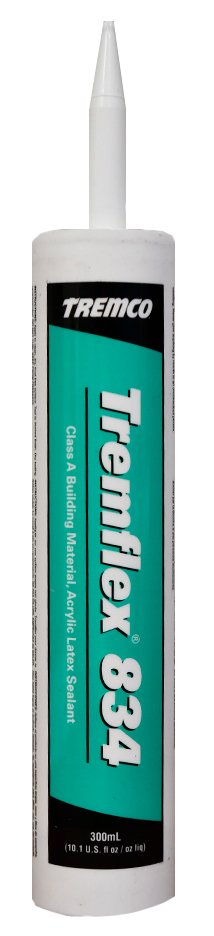
Tremco lists 300 mL cartridges, 600 mL sausages and 18.9 L pails. The estimates below use its published coverage rate and the equivalent gallon volume shown in its pail packaging.
A 600 mL sausage calculates out to about 14.9 m (48.9 ft) in a 1/4 × 1/4 in. joint, dropping to 7.4 m (24.4 ft) in a 1/2 × 1/4 in. joint. For those same two joint sizes, you’d get about 7.4 m (24.4 ft) and 3.7 m (12.2 ft) from a 300 mL cartridge. All calculated figures, before waste.
You’ll use twice as much sealant per metre in the second joint because its cross-sectional area is twice that of the first. These estimates cover only the joint dimensions shown, with no allowance for waste. For a calculation that accounts for your joint size and how efficiently you use the sealant, Tremco directs you to its usage calculator.
Turn your measurements into an order
Don’t round up each run on its own. Measure the runs, put lengths with the same width and sealant depth together, and calculate how much each group needs. Add those quantities, then round up to whole cartridges.
Five cartridges, plus a separate waste allowance: that’s what you’d allow for a 30 m run of 1/4 × 1/4 in. joint. The arithmetic is 30 m ÷ 7.45 m per 300 mL cartridge, which gives about 4.03 cartridges. Round up to five before adding waste.
Don’t treat that rounded quantity as a fixed waste allowance. Decide what extra material to carry for your job separately; the supplied sheet doesn’t specify a waste percentage.
Check the depth before using the table
Use the sealant depth for your calculation, which may be less than the full depth of the open gap. To control that depth, Tremco recommends polyethylene backer rod. Too shallow for rod? Tremco specifies polyethylene bond breaker tape there to prevent three-sided adhesion.
For expansion joints, the sheet gives a minimum sealant width and depth of 1/4 × 1/4 in. For joints from 1/2 to 1 in. wide, sealant depth should be approximately half the width, with a maximum depth of 1/2 in. Contact Tremco for joints wider than one inch.
Sealing around a window or door with an angle bead? Don’t apply the rectangular-joint table directly. Tremco calls for at least 1/4 in. contact onto each substrate and release at the heel using backer rod or bond breaker tape.
Before you order
Keep the dimensions consistent. Tremco prints 6 × 6 mm beside its 1/4 × 1/4 in. coverage figure, but those metric dimensions are rounded. The estimates here follow the inch dimensions and published gallon coverage.
Check the application conditions too. Tremco requires sound, clean, dry surfaces, recommends surface temperatures of at least 5°C during application and says to keep the product from freezing.
Open the [Tremflex 834 product details](/tremflex-834/) with your total length, joint width, sealant depth and required package size beside you. If the bead shape or depth is still uncertain, send those measurements to Cranco before settling the quantity.