



Work Gloves: Which Coating for Which Job

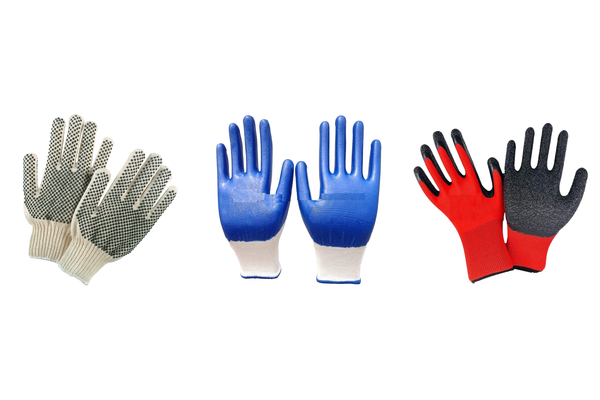
A work glove is two things: a knitted liner that fits your hand, and a coating on the outside that does the gripping. The liner decides how it feels. The coating decides what it is good for. Nearly every argument about gloves at the counter comes down to somebody choosing the coating for the wrong job.
We carry three coatings. Here is what each one is for, what the numbers on the label mean, and how to pick between them.
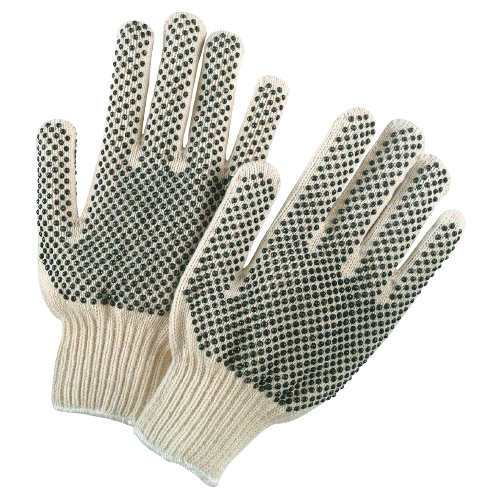
Cotton with PVC dots
A plain knitted cotton glove with small plastic dots printed across the palm and fingers. The dots stop material sliding through your hand; the cotton between them lets air through.
Use them for carrying and stacking dry material: mouldings, plywood, siding, boxes. This is the glove you wear all day when the job is handling rather than holding.
Not for oil, grease, solvent or anything wet. Cotton soaks it up and holds it against your skin.
We list them in size L, and in a 10 oz weight. The ounces are the weight of the knit: heavier is thicker and warmer, lighter is cooler and better for fine work.
Nitrile coated
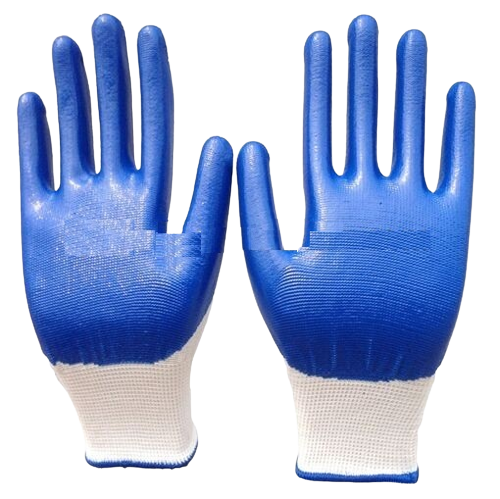
A smooth synthetic rubber coating over a knitted liner, dipped on the palm and fingers and left open across the back of the hand so the glove breathes.
Use them for anything oily or greasy, and for work where the glove has to last: handling hardware, tools, aluminum, machinery. Nitrile shrugs off oil that would ruin cotton, and it wears through more slowly than latex.
Worth knowing: nitrile contains no natural rubber latex, so it suits people who react to latex.
We list them in L and XL, blue and white, 13 gauge. We also carry an orange nitrile glove; ask at the counter which suits the job.
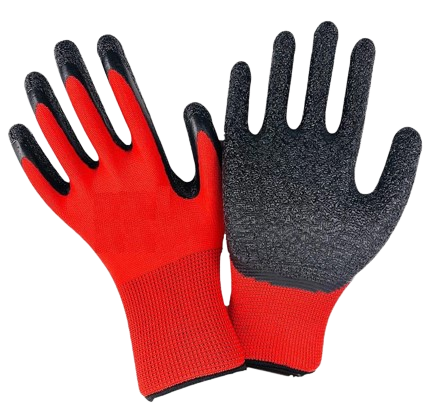
Latex crinkle
Natural rubber, put on so it sets in a wrinkled, crinkled skin rather than a smooth film. Those wrinkles are the point: they break the film of water on a wet surface, so the glove still grips when a smooth coating would slide.
Use them for wet, cold and rough work: material out of the yard in the rain, concrete, block, rough lumber, anything with a coarse or dusty surface.
Not for oil and grease, which soften natural rubber. And latex causes a reaction in some people; if anyone on the crew has one, buy nitrile instead.
We list them in L and XL, red and black, 13 gauge.
What the numbers on the label mean
| On the label | What it is telling you |
|---|---|
| 13 gauge | How fine the knit is: the number of stitches in an inch of the liner. A higher number is a finer, thinner, closer-fitting glove with better feel. A lower number, say 7 or 10 gauge, is thicker, warmer and clumsier. 13 gauge is the everyday middle: enough feel to pick up a screw, enough body to work in all day. |
| 10 oz | The weight of the cotton knit. Heavier is thicker and warmer; lighter is cooler. |
| Palm coated | The coating covers the palm and fingers and stops at the knuckles, leaving the back open. Cooler, and enough for most work. |
| Fully coated | The coating wraps the whole hand. Better against wet and dirt, hotter to wear. |
Which one for the job
| The job | The glove |
|---|---|
| Carrying mouldings, plywood, siding, boxes | Cotton with PVC dots |
| Handling hardware, tools, aluminum | Nitrile coated |
| Anything oily or greasy | Nitrile coated |
| Wet material, rain, cold, concrete or block | Latex crinkle |
| Rough or splintery lumber | Latex crinkle |
| Anyone who reacts to latex | Nitrile coated, never latex |
Fit, and why it matters more than the coating
- Too big is the dangerous one. Loose fingertips catch in tools and on edges, and a glove you cannot feel through comes off and stays off.
- Too small wears out at the fingertips in days, because the coating is stretched thin exactly where it does the work.
- Measure round the palm, not round the fingers, and try the glove with a fist. If you cannot close your hand comfortably, go up a size.
- Hands are not a pair for everyone. Fit the bigger one.
What a work glove does not do
This matters more than anything else on the page, because the mistake is always the same one: assuming the glove covers more than it does.
- It is not cut resistant. None of these three is a cut-resistant glove. Glass, sheet metal edges and blades need a glove made and rated for cutting.
- It is not chemical protection. A coated work glove keeps your hands clean; it is not a barrier against solvent, acid or fuel. Chemical work needs a glove chosen against that chemical, and the product's own safety data sheet says which.
- It is not for heat. Rubber coatings melt. Keep them away from torches, hot metal and grinding sparks.
- It is not for moving machinery. Never wear a glove near a drill press, a bench saw or anything else that can catch it and pull your hand in.
Keeping them
- Cotton gloves wash. Coated gloves mostly do not: washing softens the coating and it starts to peel. Rinse mud off in cold water and let them dry away from a heater.
- Dry them palm up. A coated glove dried with the palm down holds water against the coating.
- Replace a glove when the coating is worn through at a fingertip, when it is stiff with dried sealant, or when the liner has a hole. A glove you cannot grip with is more dangerous than no glove, because you trust it.
- Keep a clean pair aside for finished work. The pair that carried the plywood will mark a painted door.
All three are in stock at the counter, with safety glasses, face masks, floor runners and drop cloths. See safety products, or the rest of the accessories. Tell the counter in Concord, Barrie or Mississauga what the job is and we will tell you which glove suits it.