



Suction Cups and Vacuum Lifters: How They Hold, and What They Hold

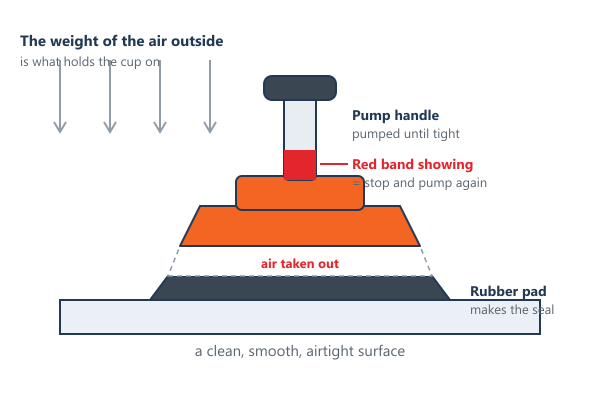
A suction cup does not pull. Nothing inside it grips anything. What happens is that the cup takes the air out from under a rubber pad, and the weight of the air outside, pressing on everything all the time, holds the pad against the surface. That is the whole mechanism, and every rule about using one follows from it.
Follow it through and three things become obvious. The surface has to be airtight, or there is nothing to hold. The pad has to seal perfectly, or the air creeps back. And the hold is not permanent: it leaks, slowly, from the moment you set it.
Two kinds, and the difference matters
Lever cups, sometimes called cam cups, are the common ones. You press the cup down and flip the lever; the lever lifts the middle of the pad and makes the empty space. Fast, nothing to maintain, and you can see at a glance whether the lever is down.
Pump cups, usually called vacuum cups, have a small hand pump on top. You set the cup and work the plunger until it is tight. They pull a harder vacuum than a lever and they hold on surfaces a lever will not. They also tell you when the hold is going, either with a red band that appears on the plunger or with a small gauge on the body.
That warning is the only one you get. It is not a suggestion. When the red band shows, or the needle drops into the red, the cup has lost vacuum: stop, set the load down if you can do it safely, and pump it again.
Check it before you lift, and keep checking it while the load is in your hands. A cup that was solid five minutes ago is not necessarily solid now.
What we carry
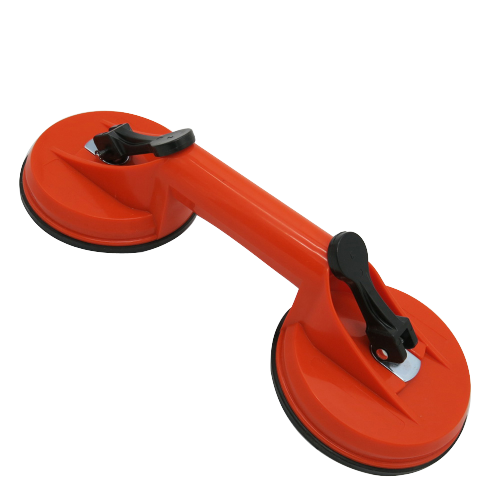
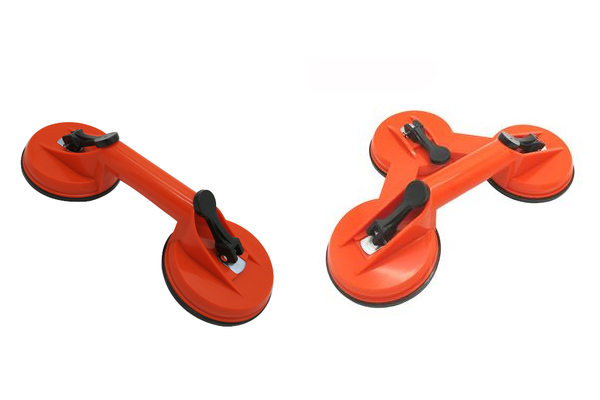
Dual suction cup. Two cups on one handle. The everyday lifter for glass, panels and sheet material, and the one to reach for first.
Listed at 4.64 in cup diameter, 7 mm pad thickness, rated 132 lb.
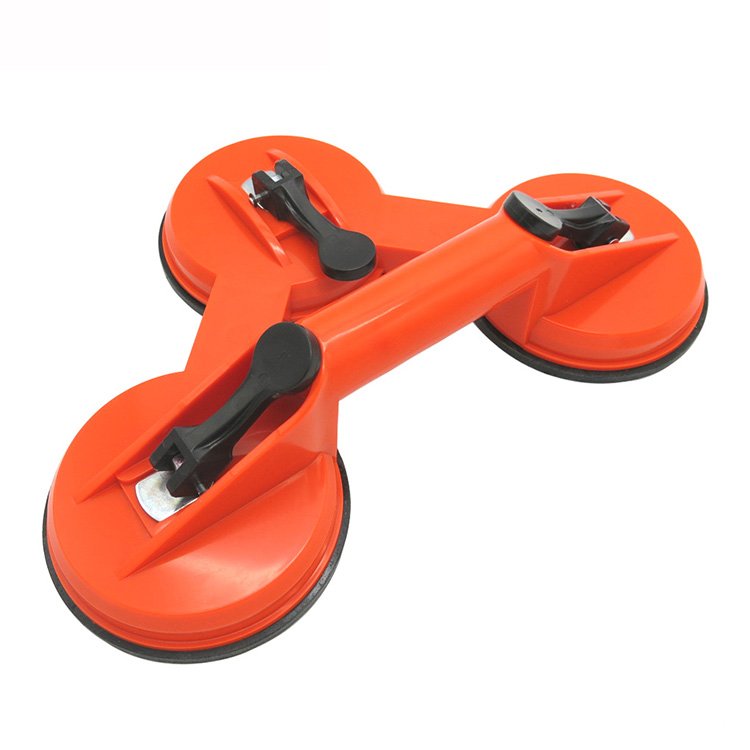
Triple suction cup. Three cups in a triangle. The third cup stops the load pivoting on the line between two, which is what you want on a large or awkward sheet.
Listed at 4.64 in cup diameter, 7 mm pad thickness, rated 132 lb.
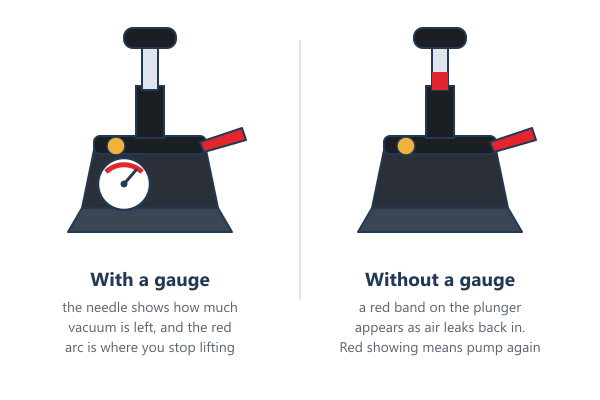
Vacuum suction cup. The pump type, for when a lever will not hold or the load has to stay put while you work.
These come two ways, and the difference is only in how they tell you the vacuum is going. With a gauge, a needle shows how much is left and a red arc marks where you stop. Without one, a red band appears on the plunger as air leaks back in.
Neither is better made than the other. A gauge gives you warning earlier; a band is one less thing to break. Ask at the counter which we have in.
What the rating means, and what it does not
A number like 132 lb is what the cup held in a test: on clean, dry, flat, smooth material, pulled straight out from the surface, with a perfect pad. Your job is none of those things.
- Work well under the rating. Treat it as a ceiling that was measured in ideal conditions, not a working load.
- The rating assumes a straight pull. A cup holds far less when the load hangs sideways or the pull peels at one edge, and peeling is how a cup actually lets go.
- Never lift over anybody, and never put yourself under the load. Glass that lets go does not give a warning.
- Two cups and two people for anything big. A sheet that is too heavy for one person is too heavy whatever the cup is rated at.
- A cup is for lifting and placing, not for anchoring, not for hanging something, and never for holding a person.
Which surfaces hold, and which do not
| Holds | Does not hold |
|---|---|
| Glass, mirror, sealed glazing units | Concrete, block, brick |
| Finished aluminum and vinyl sheet | Rough sawn lumber, unfinished plywood |
| Sealed laminate and melamine | Bare MDF and particle board edges |
| Polished stone and gloss tile | Textured or embossed vinyl |
| Smooth painted panels, fully cured | Fresh paint, dust, frost or grit |
The test is not the material, it is the surface. Anything porous lets air through from behind and the vacuum bleeds away; anything textured means the pad only touches the high spots. If you can see a pattern in the surface, the cup can too.
Using one properly
- Clean both faces. Wipe the surface and wipe the pad. One grain of grit under the rubber is a leak, and a leak is the whole failure.
- Set the cup flat and in the middle of the area you are lifting, away from an edge.
- Flip the lever, or pump until tight. On a pump cup, keep pumping until the plunger stops moving easily.
- Test it before you trust it. Pull hard while the load is still supported. If it moves at all, take it off, clean and set again.
- Watch it while you carry. On a pump cup, watch the band. On a lever cup, watch for the pad creeping at the edge.
- Re-set on a long job. Every cup leaks eventually. If the load has been hanging for a few minutes, set it down and set the cup again.
- Release deliberately, with the load supported, not by pulling until it gives.
Looking after the pad
- The rubber pad is the whole tool. Everything else is a handle.
- Wash it with water and a little soap when it stops holding; a dusty pad is the usual reason a good cup goes off.
- Store it face up, or in its case, never pad down on a concrete floor.
- Keep it out of the sun. Ultraviolet hardens rubber, and a hard pad cannot seal into the small irregularities of a surface.
- Retire a pad with a nick in it. A cut across the sealing face will never hold again, and it fails without warning.
- Cold stiffens rubber. On a winter morning, warm the cup in the cab before you trust it.
Which one for the job
| The job | The cup |
|---|---|
| Carrying a glass unit or a mirror | Dual, one in each hand, two people on anything large |
| A large or awkward sheet that wants to swing | Triple |
| Setting a panel and holding it while you fix it | Vacuum, and check the band |
| A surface that is smooth but not perfect | Vacuum, which pulls harder than a lever |
| Lifting a tile or a stone slab into place | Dual or triple, depending on size, never over your feet |
All three are at the counter with the rest of the hand tools, and the gloves and safety gear that should go with them. Tell us what you are lifting and where it has to go, in Concord, Barrie or Mississauga, and we will tell you which cup to take.