



Door and Window Casing: Colonial, Tudor or Step Bevel

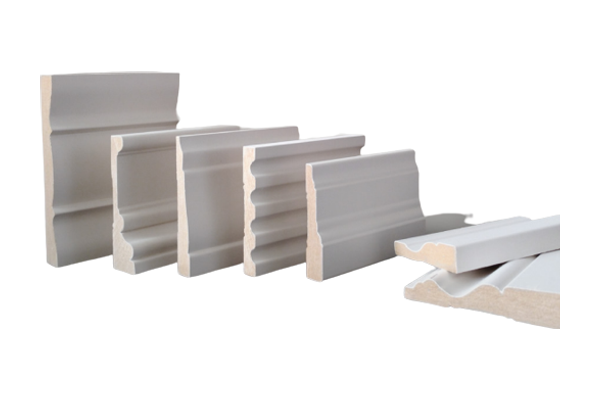
Casing is the trim around a door or window opening. It covers the joint between the frame and the wall, and it is the first thing anyone notices about a finished opening.
When you are matching existing trim, the profile name is only half the answer. Colonial casing alone comes in three face widths, so the face width and thickness decide the rest.
The profiles we carry
Our pine casing is finger-joint pine, primed on all sides. The catalogue lists these profiles and sizes:
| Profile | Face width | Thickness | Length |
|---|---|---|---|
| Colonial | 2 3/4 in | 1/2 in | 90 or 168 in |
| Colonial | 3 1/8 in | 5/8 in | 192 in |
| Colonial | 3 1/2 in | 5/8 or 3/4 in | 90 or 192 in |
| Tudor | 3 1/2 in | 3/4 in | 192 in |
| Step Bevel | 2 3/4 in | 3/4 in | 192 in |
| Step Bevel | 3 1/2 in | 3/4 in | 90 or 192 in |
| Back Band casing | 3 3/8 in | 7/8 in | 192 in |
| Side Step | 3 1/2 in | 3/4 in | 192 in |
| Cosmopolitan | 3 1/2 in | 3/4 in | 192 in |
A 90 in length is 7 1/2 ft and a 192 in length is 16 ft.
Colonial
The profile we list in the most sizes: three face widths, 2 3/4 in, 3 1/8 in and 3 1/2 in.
Tudor
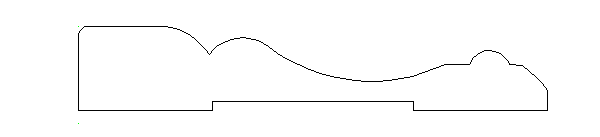
Listed at 3 1/2 in by 3/4 in, in 16 ft lengths.
Step Bevel
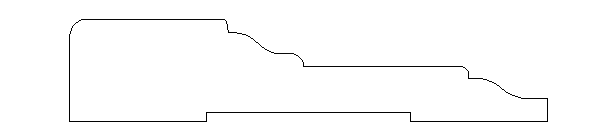
Listed in 2 3/4 in and 3 1/2 in face widths. We also carry Step Bevel baseboard and a Step Bevel door stop, so a whole room can carry the same profile.
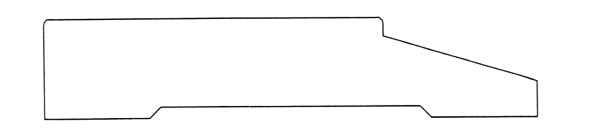
Back Band casing
The thickest casing we list, 3 3/8 in by 7/8 in, in 16 ft lengths.
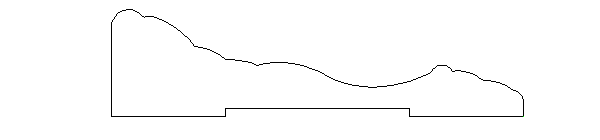
Pine or MDF
We also list MDF casing in Colonial (2 3/4 in and 3 1/2 in) and Step Bevel (3 1/2 in), in 14 ft lengths. Since June 1, 2025 all MDF casing is special order, and Step Bevel in MDF is marked coming soon, so ask about timing before you plan the job.
The MDF listing does not name a moisture-resistant grade. If the trim is going into a damp location, tell the counter where it will be installed.
How to match existing trim
- Bring an offcut or a clear photograph of the end of the trim.
- Measure the face width, the broad face you see on the wall.
- Measure the thickness at the thickest edge.
- Count the lengths you need, allowing for the mitres at each corner.
Casing is not the jamb
Casing sits on the face of the wall. The jamb is the side of the frame itself. If the frame stops short of the finished wall surface, the casing will not sit flat until the jamb is extended. See flat or V-groove jamb extensions.
We can cut casing to your list. Ask about cutting and delivery, or see all pine casing and MDF casing.
Bring the profile or an offcut, the sizes and the number of lengths to the counter in Concord, Barrie or Mississauga, and we will confirm the order before you travel.