



Sika Boom Use
Posted
Sika Boom is a gun-applied polyurethane foam. Which can you grab depends on the temperature, and how much you get out of it depends on how you prep the joint.
Sika Boom is a one-component, low-expansion polyurethane foam that goes through a dispenser gun. You use it to fill gaps and voids, seal penetrations in walls and floors, air seal and insulate, and set window and door frames. The can you pick is decided by the temperature at the joint, not by the label you used last time.
Sika Boom AS-PRO applies between -12°C and 30°C. Sika Boom ARCTIC applies between -25°C and 30°C. Both are low expansion, both are CFC and HCFC-free, and both list a low VOC content under 2.0 g/L. If the joint is cold enough that AS-PRO is out of range, ARCTIC is the one that still works.
Which Sika Boom can fits the job
AS-PRO is the all-season multipurpose can. Its application range is -12°C to 30°C, and it carries a UL 723 (ASTM E84) and CAN/ULC-S102-10 classification with a flame spread of 10 and smoke developed of 15. If your work is interior, above -12°C, and the spec calls for that fire classification, AS-PRO is the straightforward pick.
ARCTIC is the same family of foam built for cold. Its application range runs down to -25°C, and Sika lists temperature-controlled environments, refrigerated warehouses and commercial freezers among its uses. It does not carry the AS-PRO fire classification, so don't treat the two as interchangeable where that rating is required.
The two cans differ in yield. AS-PRO is listed at 40 L (± 5 L) per 750 mL can. ARCTIC is listed at 65 L (± 5 L), with a high yield up to 70 L. Both figures depend on temperature and humidity, and Sika states plainly that lower temperatures decrease yield and curing time. Cold foam gives you less volume per can and takes longer to set.
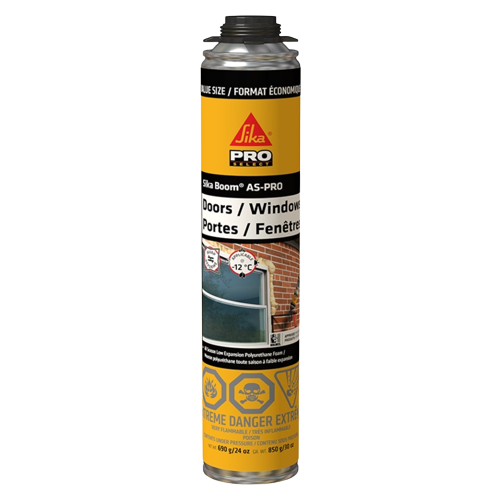
- Sika Boom AS PRO The gun foam this guide is about.
- Contact Cranco
Before you pull the trigger
The foam needs a gun. Sika Boom AS-PRO is applied with the Sika Boom PRO Dispenser gun, and the same gun takes the PRO Cleaner. If you don't have the gun and cleaner on the truck, you're not set up to run this product.
Precondition the can. Sika's ARCTIC sheet calls for the product to be preconditioned at a minimum of 5°C, and both sheets specify storage between 5°C and 30°C, upright, dry, out of direct sunlight. A can that sat in a cold truck overnight is not ready to use just because the outdoor temperature is inside the application range.
Check the shelf life before you load the gun. Both foams are listed at 15 months from the date of production when stored properly in undamaged, original, sealed packaging. Storage above 30°C or below 5°C shortens that.
Applying the foam
Clean the joint first. Loose material, dust and grease give the foam something to bond to that isn't the substrate. The PRO Cleaner sheet notes the cleaner will also remove grease from contaminated substrates, which tells you grease is a real problem on these surfaces.
Fit the can to the gun, then dispense into the gap. This is a low-expansion foam, and that's the point: Sika lists low expansion as the reason it helps prevent bowing or warping of window frames and other elements. You still don't want to bury the joint. Fill the void and let the foam do its work.
Watch the clock. Tack-free time at 1 cm width is 6 ± 2 minutes on both sheets. Cutting time at 1 cm width is 20 to 45 minutes. Cure time is 24 hours. Those are three different numbers for three different stages, and the cutting time is not a recoat instruction — it's when you can trim the foam back flush.
Outdoor work and UV
Cured Sika Boom will discolour if it's exposed to ultraviolet light. Both sheets say the same thing: paint or coat cured foam for best results in outdoor applications. If the foam is going to sit in the sun, plan the coating as part of the job, not as a callback.
Service temperature on both foams is -40°C to 80°C. That's the range the cured foam is rated to sit in, not the range you can apply it in. Keep the two separate when you're reading the sheet.
Cleaning the gun and the mess
Sika Boom PRO Cleaner is an aerosol solvent cleaner for the Sika Boom PRO Dispenser gun. It removes fresh, uncured polyurethane foam from dispensing equipment and from other surfaces, and Sika lists consumption at up to 15 gun cleanings per 500 mL can. It can be used on its own or screwed directly onto the gun.
The window is short. Once the foam has cured, the cleaner won't touch it — Sika states that cured foam can only be mechanically removed. Clean the gun after use, not the next morning.
The cleaner is not safe on everything. Sika warns it can partially dissolve or discolour sensitive substrates including varnish, paint, plastics and textiles. Test it on an offcut or a hidden spot before you spray it across a finished surface. It's also a pressurised container, with an application temperature of 5°C to 30°C and a service temperature of 0°C to 30°C.
Where Sika Boom jobs go wrong
Buying the wrong can for the temperature. AS-PRO stops at -12°C. If you're foaming a penetration in an unheated building in January, that's ARCTIC territory, and the yield difference between the two cans matters when you're planning how many to load.
Expecting the listed yield in the cold. Both sheets tie yield to temperature and humidity, and both state that lower temperatures decrease yield. A 40 L can does not give you 40 L at -10°C.
Leaving the foam exposed outside. UV discolouration is listed as a limitation on both sheets. Coat it or cover it.
What is Sika Boom used for?
Sika Boom is a gun-applied polyurethane foam for filling gaps and voids, sealing penetrations in walls and floors, air sealing and insulating, sealing out dust, noise and draft, and installing window and door frames. Sika Boom ARCTIC adds temperature-controlled environments such as refrigerated warehouses and commercial freezers to that list.
What temperature can you apply Sika Boom in?
Sika Boom AS-PRO applies between -12°C and 30°C. Sika Boom ARCTIC applies between -25°C and 30°C. Both have a service temperature of -40°C to 80°C once cured, which is a different number from the application range.
How long does Sika Boom take to cure?
Both AS-PRO and ARCTIC list a tack-free time of 6 ± 2 minutes at 1 cm width, a cutting time of 20 to 45 minutes at 1 cm width, and a cure time of 24 hours. Lower temperatures decrease curing time.
Can you clean up cured Sika Boom foam?
No. Sika Boom PRO Cleaner removes fresh, uncured foam from the gun and from other surfaces, but Sika states that cured foam can only be mechanically removed. Clean the gun right after use.